Want to dive even deeper? Check out our

Cerebrospinal Fluid 101

A general overview of cerebrospinal fluid’s complexities and pathophysiology. 

Cerebrospinal fluid (CSF) is an important, complex and multifunctional substance of the central nervous system. If there is any disturbance in the production or its movement, it has immediate and long-term consequences that affect the brain and spinal cord. Idiopathic intracranial hypertension (IIH) is a condition where it is hypothesized that there is an abnormality of the production and/or the circulation of CSF, which contributes to the signs and symptoms of this neurological disorder.
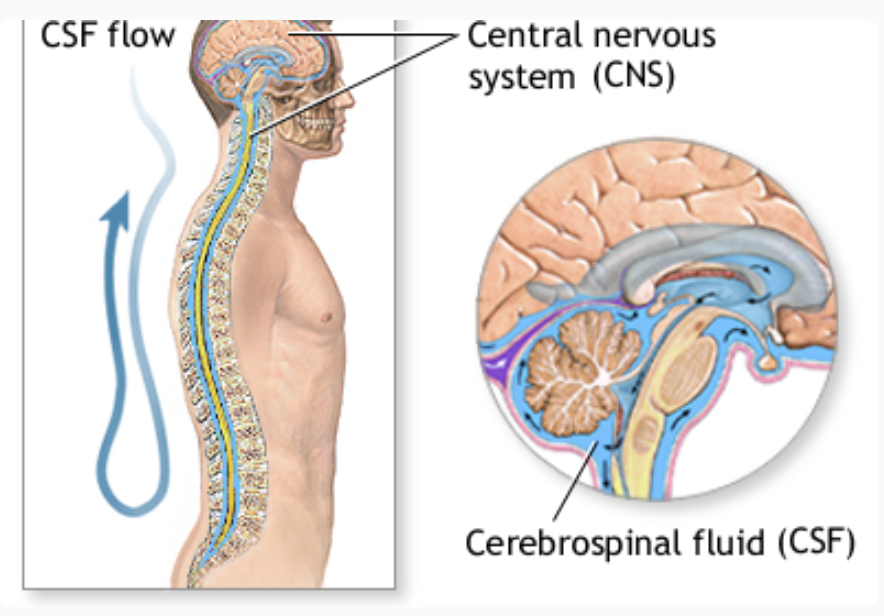
 

Cerebrospinal fluid (CSF) is a natural substance that moves around your brain and spinal cord and has many functions. Normal CSF provides nutrients and oxygen to the brain and spinal cord and removes waste products. The right amount of CSF acts as a protective barrier against impact like trauma. When the circulation of CSF is on track, it keeps the brain and spine healthy by keeping toxins and organisms from infecting the central nervous system. Most importantly CSF regulates cerebral blood flow, allowing for your brain to perform essential functions like cognition, movement and controlling your heart to name a few. 
Cerebrospinal fluid functions:

  • Provides nutrition to the brain and spinal cord
  • Removes waste products of the brain and spinal cord
  • Provides oxygen to the brain and spinal cord
  • Acts as a cushion to protect the brain and spinal cords against injury
  • Defends against harmful chemical and biological agents
  • Regulates cerebral blood flow

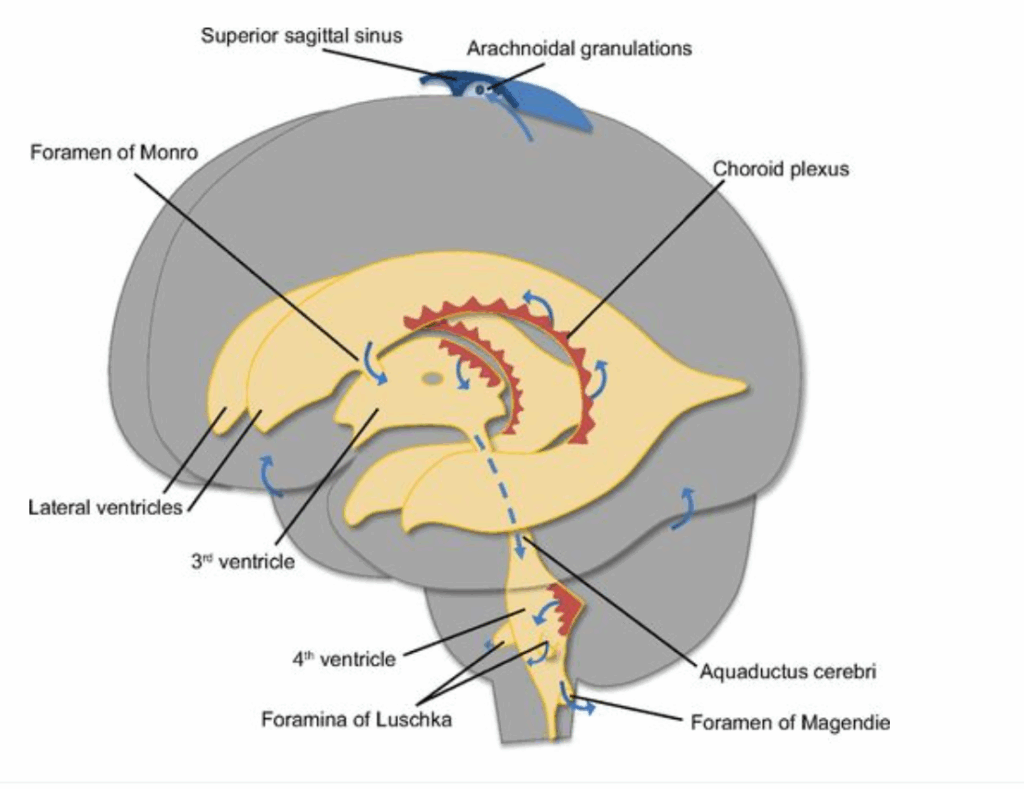
Cerebrospinal fluid is made in the blood vessels found in the ventricles of the brain, called the choroid plexus. From there, CSF flows through the ventricles, the subarachnoid space, and the central canal of the spinal cord. Once the CSF has performed its functions of providing nutrients, delivering oxygen, and removing waste products, it is reabsorbed into the bloodstream. Your body makes about 500-600 mL of CSF a day and about 150 mL is moving around at any given time. 

There are many reasons that inhibit cerebrospinal fluid to perform its functions. The 3 main reasons are: an issue causing low pressure, an issue causing high pressure, and composition abnormalities. 

  1. An issue with low pressure. If there is a hole in the wall that houses CSF, a leak will occur. The layer or wall that is affected is the dura mater. When there is a hole in the wall, CSF escapes and causes low pressure; this is called a CSF leak. Signs and symptoms of IIH can occur in this situation.
    • In a traumatic setting, like an injury or accident or during surgery when the surgeon is operating close to the dura mater of the brain or spinal cord.
    • In a controlled setting like a lumbar puncture.
    • Connective tissue disorders
    • Bony abnormalities of the spine
  2. Increased intracranial pressure (ICP). High pressure in and around the brain can cause a defect to occur, causing a leak of CSF as well as putting strain on the brain, spinal cord and associated structures. IIH is associated with elevated pressures in the brain causing debilitating signs and symptoms. If left untreated, changes in the brain can be permanent. Though the exact reason IIH develops is unknown, there are some known reasons why elevated pressure occurs when CSF is not working properly:
    • Venous Fistulas. This is an abnormal connection between the dura and the veins and can cause CSF to drain directly into the bloodstream. 
    • Hydrocephalus. Hydrocephalus is the buildup of CSF in the brain’s ventricles, increasing pressure on brain tissues and structures. 
    • Obstruction. A tumor, infection and other abnormalities can narrow the pathway of CSF causing a blockage; therefore increasing brain pressures. 
    • Poor Absorption. The inability of the body to reabsorb CSF back into the bloodstream.
    • Overproduction. The choroid plexus can produce fluid faster than it can be absorbed. 

Normal cerebrospinal fluid is clear and colorless. When there is infection or bleeding in the brain or spinal cord, the composition of CSF can change. This change can prevent CSF from performing properly. 

  1. Infection. Bacteria, fungus and viruses can change the composition of CSF and not allow it to perform its vital functions.
  2. Bleeding. Blood in the CSF can come from surgery, trauma or a ruptured aneurysm. 
  3. Inflammatory or Autoimmune Conditions. Multiple sclerosis and Guillain-Barré can change the makeup of CSF, precluding it from performing its functions. 

This article is a brief overview of cerebrospinal fluid and its complexities. This article is not intended to be comprehensive but as a general overview of its pathophysiology. 

Resources:

1.https://ufhealth.org/conditions-and-treatments/csf-oligoclonal-banding

2. Cerebrospinal Fluid Secretion by the Choroid Plexus. Helle H. Damkier, Peter D. Brown, and Jeppe Praetorius Physiological Reviews 2013 93:4, 1847-1892

Related articles

You are not alone

This hub is filled with resources to help you navigate IIH. Sign up for our mailing list to receive monthly updates about new tools and resources.

Patient stories

Jim

“My instincts told me that I had to keep pushing and that I had to keep my body as active as possible because I didn’t know where all of this was leading. “
“I know everyone says to trust your gut, so I’ll say trust your headache. Your pain is real, and ‘borderline-ish’ does not serve anyone.”

Like what you are seeing?

Join our next webinar.

Thank you! You’re registration is complete for:

Coming Soon